联系我们
HKUST(GZ)
我的门户
  • EN
  • ZH
  • ZH
  • 关于系统枢纽
    • 枢纽领导
    • 愿景与使命
    • 事实数据
    • 我们的团队
  • 学域
    • 生命科学与生物医学工程
    • 智能交通
    • 机器人与自主系统
    • 智能制造
  • 教育项目
    • 研究型硕博教育
    • 本科生教育
  • 研究与知识转移
    • 研究项目特色
    • 知识转移特色
  • 新闻与媒体
    • 活动
    • 新闻稿
    • 视频
    • 社交媒体
  • 加入我们
    • 联系我们
    • 招聘
活动 - 系统枢纽

新闻与媒体

> 新闻与媒体 > 活动
  • 活动
  • 新闻稿
  • 视频
  • 社交媒体
  • SC²I x IEEE ComSoC × IEEE SPS GZ Chapter Distinguished Lecture | Prof. Qiang Ye from Dalhousie University
    03 7 月 2026

    Over the past few years, machine learning has been widely utilized to enhance cybersecurity. In this talk, we will present two of our recent projects in this area: the use of autoencoders to defend against adversarial attacks and the detection of darknet traffic over Tor. In the first project, we observed that machine learning-based intrusion detection systems (IDSs) have become increasingly popular due to their strong detection capability and adaptability.

    智能交通
  • INTR Seminar | Dr. Tram Tran and Dr. Xinyan YU from The University of Sydney
    29 5 月 2026

    What does it feel like to cross the road in front of a car with no driver? Or to watch a delivery robot get stuck on a footpath and wonder “do I help”? This presentation takes these everyday encounters seriously. Drawing on research in autonomous vehicles–pedestrian interaction and human–robot collaboration, we explore how pedestrians and bystanders navigate a world increasingly shared with autonomous systems, and what design research can do to make those interactions feel more natural, legible, and human.

    智能交通
  • INTR Seminar | Prof. Xintao YAN from University of Hong Kong
    20 4 月 2026

    Autonomous Vehicle (AV) technology holds the promise of transforming future transportation systems, but its large-scale deployment requires rigorous safety evaluation. To address this need, we propose a behavioral safety assessment program to evaluate AV driving intelligence, consisting of two key components: (1) high-fidelity simulations that replicate real-world driving conditions, and (2) efficient testing strategies to accelerate validation. Central to this is modeling a Naturalistic Driving Environment (NDE) with distribution-level accuracy. We develop a deep learning-based framework to simulate statistically realistic human driving behavior, particularly for those long-tail safety-critical events. However, directly testing in the NDE is inefficient due to the rarity of such events. To address this, we introduce the Naturalistic and Adversarial Driving Environment (NADE), reducing test mileage without sacrificing accuracy. The proposed AV behavioral safety assessment program has been successfully deployed at physical testing facilities for real-world AV evaluation.

    智能交通
  • INTR Seminar | Prof. Zhibin CHEN from New York University Shanghai
    02 4 月 2026

    Modular autonomous vehicles (MAVs) are transforming transit design through en-route (de)coupling and in-motion transfer. To evaluate this disruptive technology, we conduct a comprehensive cost-effectiveness analysis of an MAV-based system featuring a main corridor service integrated with local pick-up-and-delivery routes. We develop a continuum approximation (CA) model to quantify passenger and agency costs, comparing it against traditional fixed-route and on-demand services. Our analysis uncovers the complex interactions between system parameters and performance, identifying favorable operating regimes and providing managerial guidance for modular transit implementation.

    智能交通
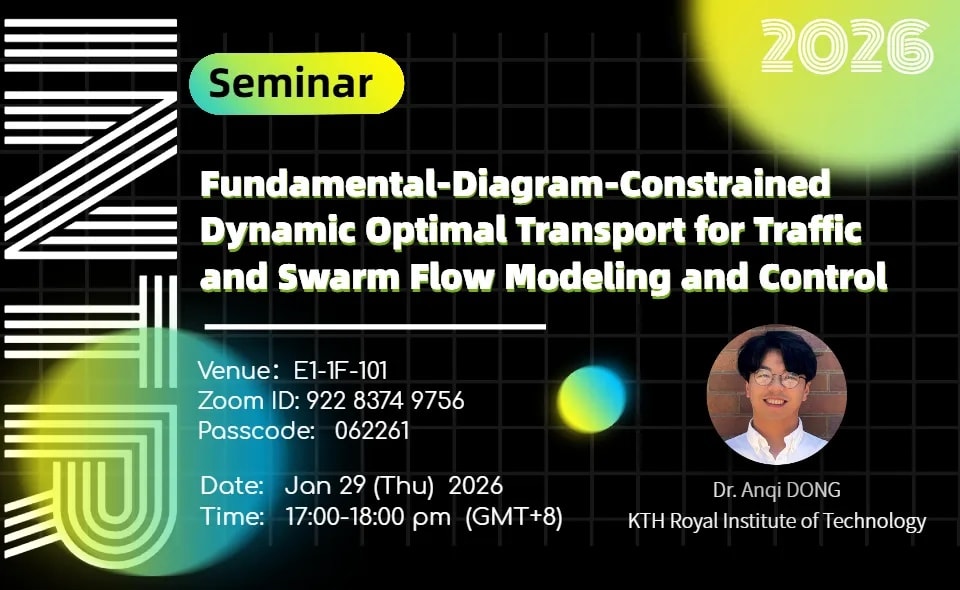
  • INTR Seminar | Dr. Anqi DONG from KTH Royal Institute of Technology
    28 1 月 2026

    Ninety years ago, Greenshields’ 1935 study of vehicular flow introduced what we now call the fundamental diagram. It captures a basic congestion effect: as density increases, speed drops from its free-flow value and goes to zero as density approaches the jam level. This simple relation gives a constitutive law that closes macroscopic traffic equations, and it underpins classical continuum models such as LWR and later second-order variants. In parallel, optimal transport has developed into a general framework for how distributions move under constraints. It is now widely used in swarm control, inference, and diffusion-based generative modeling. The viewpoint is to evolve densities rather than track individuals, and to choose the evolution that minimizes an action, often a kinetic-energy-type cost.

    智能交通
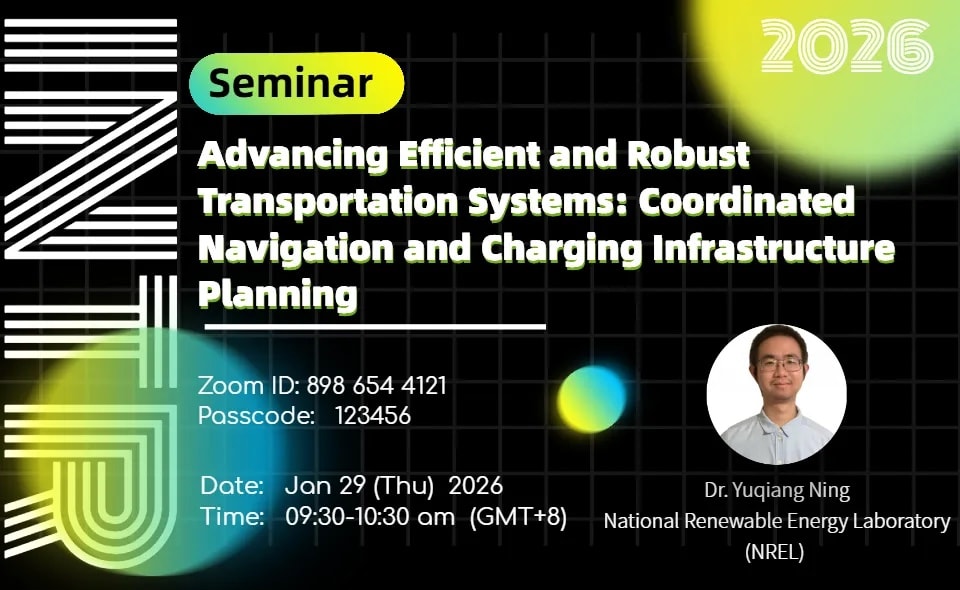
  • INTR Seminar | Dr. Yuqiang Ning from National Renewable Energy Laboratory (NREL)
    26 1 月 2026

    Transportation systems are essential to economic activity and social mobility, yet they face growing challenges from rapid urbanization, increasing travel demand, and the expanding integration of emerging technologies. This talk will cover part of my research that aims at advancing efficient and robust transportation systems, from both the operational decision-making and infrastructure planning perspective.

    智能交通
  • INTR Seminar | Prof. Zhenghao Ding from Hunan University
    14 11 月 2025

    Structural health monitoring (SHM) is crucial for ensuring the safety, durability, and operational efficiency of civil infrastructure such as bridges and buildings. Traditional monitoring methods are limited by low accuracy, high computational costs, and poor adaptability to complex working conditions, making it difficult to meet the demands of real-time and intelligent evaluation. Computational intelligence has emerged as a quite popular means for advancing SHM, addressing these limitations through applying innovative algorithmic structures or modifications.

    智能交通
  • SC²I Seminar | Prof. Kai Zhou from PolyU
    05 11 月 2025

    This talk will address the critical challenge of ensuring the robustness of graph learning models by walking through a structured, three-step processing pipeline. We will begin by dissecting adversarial attacks, exploring how graph-structured data can be subtly manipulated to mislead model predictions. The discussion will then pivot to defense strategies, first covering empirical defense methods that have shown practical promise but lack formal guarantees. Subsequently, we will delve into the more rigorous field of certified...

    智能交通
  • INTR Seminar | Dr. Ilya Jackson from MIT
    28 10 月 2025

    Modern global supply chains exhibit complex, multi-tier dependencies that remain largely invisible to decision-makers, creating vulnerabilities to cascading disruptions. This presentation introduces a novel AI-driven methodology that combines data scraping, generative AI, and network science to illuminate deep-tier supply chain networks and quantify systemic risks. The approach leverages diverse data sources—including 10-K filings, earnings calls, and trade databases—to construct large-scale supply chain networks spanning over 55,000 firms, 230,000 relationships, 93 countries, and 278 industries, enabling...

    智能交通
  • IEEE ComSoC x SC2I Distinguished Lecture | Prof. Sinem Coleri
    10 10 月 2025

    Unlike previous generations of wireless networks, which were primarily designed to meet the requirements of human communications, 5G networks enable extensive data collection from machines. As we transition to 6G, the emphasis moves beyond connectivity toward leveraging this machine-generated data for a new spectrum of control applications, such as UAV swarms, collaborative robots, and cooperative autonomous vehicles. Designing communication systems for these advanced control applications introduces a distinct set of challenges. These include meeting stringent...

    智能交通

文章导航

1 2 3 4 … 10
搜索
筛选
关注系统枢纽
  • 关于系统枢纽
  • 学域
  • 教育项目
  • 研究与知识转移
  • 新闻与媒体
  • 加入我们
© 版权属香港科技大学(广州)所有 粤ICP备20065231号