联系我们
HKUST(GZ)
我的门户
  • EN
  • ZH
  • ZH
  • 关于系统枢纽
    • 枢纽领导
    • 愿景与使命
    • 事实数据
    • 我们的团队
  • 学域
    • 生命科学与生物医学工程
    • 智能交通
    • 机器人与自主系统
    • 智能制造
  • 教育项目
    • 研究型硕博教育
    • 本科生教育
  • 研究与知识转移
    • 研究项目特色
    • 知识转移特色
  • 新闻与媒体
    • 活动
    • 新闻稿
    • 视频
    • 社交媒体
  • 加入我们
    • 联系我们
    • 招聘
活动 - 系统枢纽

新闻与媒体

> 新闻与媒体 > 活动
  • 活动
  • 新闻稿
  • 视频
  • 社交媒体
  • ROAS Seminar丨Dr. ZHANG Shiqi
    15 4 月 2026

    Distributed algorithms play a central role in modern networked systems, where multiple agents must coordinate, reach agreement, or solve optimization problems using only local interactions. In this talk, I will present a robustness-oriented perspective on three representative classes of distributed algorithms: consensus algorithms, event-triggered consensus algorithms, and distributed optimization algorithms. The goal is to show that, despite their different formulations, these problems can be studied within a unified framework centered on robustness, performance, and network effects.

    机器人与自主系统
  • ROAS Seminar丨Dr. Jiaping XIAO
    02 4 月 2026

    With the rapid development of artificial intelligence, robotics, and autonomous systems, vision-based learning is becoming a key technological pathway for enabling intelligent systems to perceive environments, understand tasks, and make autonomous decisions. The seminar will focus on frontier research such as machine vision, deep reinforcement learning, multi-agent systems, and embodied intelligence, and will analyze how visual information can be integrated with control, planning, and learning mechanisms to enable agents to achieve efficient perception, autonomous learning, and safe operation in complex environments.

    机器人与自主系统
  • ROAS Seminar丨Dr. Fangqiang DING
    28 1 月 2026

    Large AI models have transformed the digital workspace, writing documents and code, generating media, and executing agentic workflows for humans. The next step is to bring such capabilities into the real world, enabling physical systems to perceive, understand, and interact with real-world environments, i.e., Physical AI. I envision a future human–machine symbiotic ecosystem in which human and embodied intelligence coexist, collaborate, and co-evolve. Realizing this vision requires addressing several fundamental challenges: (i) complex and ever-changing real-world conditions (e.g., illumination, weather, and disasters), (ii) stringent privacy and sensitive-content protection requirements in human-centered applications, and (iii) the tension between limited deployment budgets and expensive hardware (sensors and computation) as well as costly data and annotation pipelines. Motivated by these challenges, my research aims to advance condition-adaptive, privacy-aware, and cost-effective Physical AI.
    机器人与自主系统
  • ROAS Seminar丨Dr. Andreas Orthey
    28 1 月 2026

    This presentation introduces unified algorithms for multi-robot task and motion planning highlighting benefits like efficiency, cooperation, and redundancy. Part 1 focuses on multi-robot navigation in high-dimensional configuration spaces using Fibration Trees, enabling structural benchmarking against methods like RRT and FMT.

    机器人与自主系统
  • ROAS Seminar丨Dr. Fangqiang DING
    26 1 月 2026

    Large AI models have transformed the digital workspace, writing documents and code, generating media, and executing agentic workflows for humans. The next step is to bring such capabilities into the real world, enabling physical systems to perceive, understand, and interact with real-world environments, i.e., Physical AI. I envision a future human–machine symbiotic ecosystem in which human and embodied intelligence coexist, collaborate, and co-evolve. Realizing this vision requires addressing several fundamental challenges: (i) complex and ever-changing real-world conditions (e.g., illumination, weather, and disasters), (ii) stringent privacy and sensitive-content protection requirements in human-centered applications, and (iii) the tension between limited deployment budgets and expensive hardware (sensors and computation) as well as costly data and annotation pipelines. Motivated by these challenges, my research aims to advance condition-adaptive, privacy-aware, and cost-effective Physical AI.
    机器人与自主系统
  • ROAS Seminar丨Dr. Yifu TAO
    19 1 月 2026

    Lidar and vision have complementary sensor characteristics for robot mapping in large-scale scenes. In this talk, I will present strategies for fusing the two sensor modalities using learning-based depth estimation and radiance fields. One challenge of applying learning-based methods is the inaccuracies in the neural networks, and we show how we handle them using aleatoric and epistemic uncertainty estimation through a Bayesian perspective.

    机器人与自主系统
  • ROAS Seminar丨Dr. Zeqing ZHANG
    15 1 月 2026

    In this presentation, I will provide a comprehensive overview of my research focused on the multimodal perception and manipulation of various types of deformable objects, including cloth, liquid, belts, and granular media. To structure the discussion effectively, I will categorize these projects based on their task difficulty, specifically into classification, estimation, semi-static operation, dynamic operation, and long-term manipulation.

    机器人与自主系统
  • ROAS Seminar丨Dr. Jiaen WU
    22 12 月 2025

    For decades, researchers have sought technologies that understand and support human movement with the same sensitivity and adaptability that humans use to maintain mobility in the real world. Achieving this requires systems that are perceptive, adaptive, and scalable.

    机器人与自主系统
  • ROAS Seminar丨Prof. I-Ming Chen
    15 12 月 2025

    Industry robot manipulators have been invented for nearly 50 years. In the past, such robot manipulators are used in mass manufacturing lines and programmed manually by engineers. However, as modern manufacturing moves into low volume high mix products in a very tight schedule, it becomes very challenge to program the robots to handle large variety of products and parts and also to make changes to the manufacturing lines in a very short time. With advancement in 3D machine vision, machine learning methods and fast computing power, there is an emerging trend to put 3D perception device, machine learning technique into industry robots to make them “smart’ enough to handle a variety of products in a changing environment.

    机器人与自主系统
  • ROAS Seminar丨Dr. Lei LEI
    03 9 月 2025

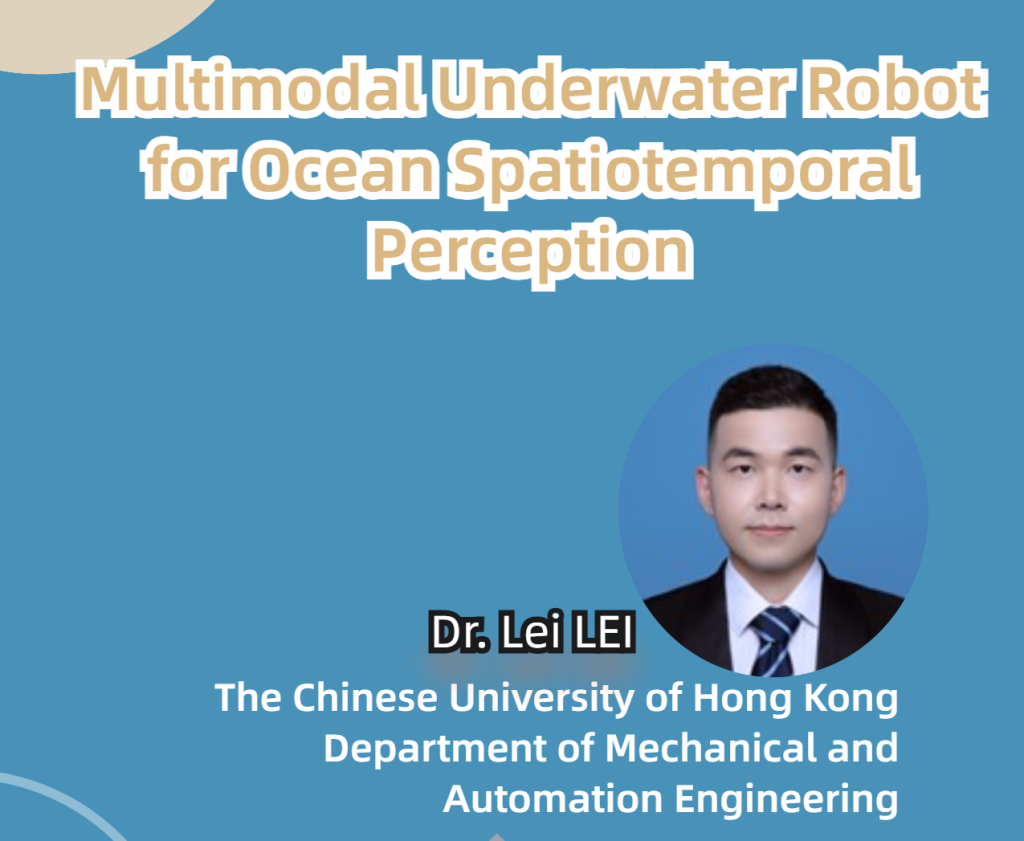
    The ocean is a complex spatiotemporal system that comprises various physical, chemical, and biological components. Their intricate dynamics influence weather patterns, shape climate trends, and play a pivotal role in maintaining the delicate equilibrium of our ecosystem.  Underwater robots have become crucial tools for exploring and understanding the vast and mysterious realms of oceans and potentially extending their applications to outer space exploration. However, due to the dynamic and uncertain ocean environments, the motion efficiency...

    机器人与自主系统

文章导航

1 2 3 4 5
搜索
筛选
关注系统枢纽
  • 关于系统枢纽
  • 学域
  • 教育项目
  • 研究与知识转移
  • 新闻与媒体
  • 加入我们
© 版权属香港科技大学(广州)所有 粤ICP备20065231号