联系我们
HKUST(GZ)
我的门户
  • EN
  • ZH
  • ZH
  • 关于系统枢纽
    • 枢纽领导
    • 愿景与使命
    • 事实数据
    • 我们的团队
  • 学域
    • 生命科学与生物医学工程
    • 智能交通
    • 机器人与自主系统
    • 智能制造
  • 教育项目
    • 研究型硕博教育
    • 本科生教育
  • 研究与知识转移
    • 研究项目特色
    • 知识转移特色
  • 新闻与媒体
    • 活动
    • 新闻稿
    • 视频
    • 社交媒体
  • 加入我们
    • 联系我们
    • 招聘
活动 - 系统枢纽

新闻与媒体

> 新闻与媒体 > 活动
  • 活动
  • 新闻稿
  • 视频
  • 社交媒体
  • BSBE Seminar丨Dr. Chengcai ZHANG from Chinese Academy of Sciences
    20 9 月 2023
    生命科学与生物医学工程
  • BSBE Seminar丨Dr. Yixin ZHAO from Cold Spring Harbor Laboratory
    12 5 月 2023

    In metazoans, both transcription initiation and the escape of RNA polymerase (RNAP) from promoter-proximal pausing are key rate-limiting steps in gene expression.

    生命科学与生物医学工程
  • BSBE Seminar丨Dr. Kai YU from Cold Spring Harbor Laboratory
    11 4 月 2023

    The central nucleus of amygdala (CeA) plays key roles in a diverse set of adaptive behaviors, including defensive and appetitive response. Early studies of CeA emphasized its function in aversive Pavlovian learning, it was described as a relay connecting basolateral complex of the amygdala to the brainstem effectors. With methodological advances, we demonstrated the somatostatin (SST) expressing neurons in the CeA was actively encoding fear memory through fiber photometry in mice undergoing fear conditioning. Closer observation activities of individual SST+ CeA neurons with endoscopy imaging revealed their roles encoding both aversive and appetitive salient events. In parallel study of PKC-δ -expressing neurons, another major population of the CeA, reveals they are essential for the synaptic plasticity underlying learning in the lateral amygdala, which challenges traditional model of fear learning.

    生命科学与生物医学工程
  • BSBE Seminar丨Dr. Liqun ZHANG from 1910 Genetics Inc
    03 4 月 2023

    Molecular dynamics (MD) simulations are statistical mechanics-based tools for predicting microscopic and macroscopic properties/dynamics based on the details of molecule-molecule interactions. They have been widely applied in biomedical and engineering fields. The application of MD on human b defensins (hBDs) type 2 (hBD-2) and type 3 (hBD-3) is covered in this talk. hBDs belong to the human innate immune system and have microbicidal activities against bacteria, fungi, yeast, viruses, in addition to having chemotactic activities. In order to understand its functional mechanism in molecular detail, the binding structure of hBD-3 on model bacterial membrane was predicted using microsecond-long MD simulations and validated by solid-state NMR method. It was found that hBD-3 binds with bacterial membrane on the two loop regions. Free energy perturbation (FEP) calculation further clarified the contribution of each residue to the membrane binding, which showed that the tail region of hBD-3 drives the process. The results emphasized the importance of electrostatic interaction in hBD-3’s binding with bacterial membrane. Besides that, it was found that hBD-2 can bind on the receptor binding domain (RBD) of SARS-CoV-2 (Cov-2) at the same site as the receptor angiotensin-converting enzyme 2 (ACE2), thus blocking CoV-2 virus from attacking ACE2 expressing cells. The result supplies insight on the role human innate immune system plays in combating CoV-2 infection.

    生命科学与生物医学工程
  • BSBE Seminar丨Dr. Cheng ZHANG from Amgen Inc.
    21 3 月 2023

    Over the past decade, programmable Cas9 nucleases have revolutionized basic research and clinical applications. However, compared to Cas9-based DNA targeting tools, there is a lack of simple and effective tools for studying and manipulating RNA. The Type VI CRISPR-Cas13 system is currently the only known efficient programmable system exclusively targeting RNA. My research is focused on the type VI-D effector protein Cas13d, which is one of the smallest effectors in the Cas13 family, making it more advantageous for packaging into adeno-associated viruses. We utilized cryo-electron microscopy (cryo-EM), biochemical approaches, and hydrogen-deuterium exchange mass spectrometry to explore the conformational landscape of Cas13d during RNA processing, and utilized the structural insights to guide Cas13d protein engineering. Additionally, we established in vitro and cellular assays of using Cas13d to achieve mRNA knockdown, pre-mRNA splicing regulation, and RNA detection, providing proof-of-concept for future RNA-centric applications. Overall, our findings have the potential to significantly advance the field of transcriptome engineering and lead to more effective gene therapies.

    生命科学与生物医学工程
  • 活动回顾 | 2022-23 BSBE春季学期暨元宵Gathering
    13 2 月 2023

    2月9日下午,生命科学与生物医学工程(BSBE)学域举办了2022-2023春季学期暨元宵庆祝活动。BSBE的全体教职工和学生(MPhil & PhD)欢聚一堂,享用丰盛的下午茶、猜灯谜、相互畅谈对学业、研究及工作的心得与收获。

    生命科学与生物医学工程
  • BSBE Seminar丨Dr. Zhenkun NA from Yale University
    28 12 月 2022

    Proteogenomic identification of translated small open reading frames in human has revealed thousands of microproteins, or polypeptides of fewer than 100 amino acids, that were previously invisible to geneticists. Microproteins have now been linked to important cellular and physiological processes as well as disease in diverse organisms. We developed a high-throughput technology for global mapping of microproteins to specific subcellular organelles by proximity labeling techniques and mass spectrometry-based proteomics. We demonstrated that this technology enables detection of hundreds of microproteins within specific subnuclear regions in cultured human cell lines and in mouse model. Meanwhile, we characterized the biological function of an intrinsically disordered microprotein, NBDY, and showed that NBDY is a master regulator of the substrate specificity of the cytoplasmic RNA decapping complex. We identified that phosphorylation of NBDY from phosphoproteomics downstream of signaling pathways that control cell division and response to growth factors is sufficient to drive the membraneless organelle (Processing bodies) disappearance in human cells.

    生命科学与生物医学工程
  • BSBE Seminar丨Dr. Shun ZHANG from MIT
    01 12 月 2022

    Self-organized microvascular networks (MVNs) have become key to thedevelopment of many microphysiological models. However, the selforganizing nature of this process, combined with variations between types orbatches of endothelial cells (ECs) often leads to inconsistency or failure toform functional MVNs Here, I will present two distinct approaches we havebeen using to tackle those problems.

    生命科学与生物医学工程
  • BSBE Seminar丨Dr. Liang GUO from Amazon.com, Inc.
    27 10 月 2022

    Therapeutic intervention for Parkinson’s disease (PD) via deep brain stimulation (DBS) represents the current paradigm for managing the advanced stages of the disease in patients when treatment with pharmaceuticals becomes inadequate. Although DBS is the prevailing therapy in these cases, the overall effectiveness and reliability of DBS can be diminished over time due to biocompatibility issues with the electronic implants. To achieve a lifetime solution, this talk envisions that the next generation of neural implants will be entirely “biological” and “autologous”, both physically and functionally. Thus, in this work, we set forth toward developing a biological brain pacemaker (BBP) for treating PD. Our focus is to investigate engineering strategies for creating a multicellular biological circuit that integrates innate biological design and function while incorporating principles of neuromodulation to create a biological mechanism for delivering high-frequency stimulation with cellular specificity. We engineer a 3D multicellular circuit design built entirely from biological and biocompatible components using established tissue engineering protocols to demonstrate the feasibility of creating a living neural implant. Furthermore, we show we can organize cellular materials to create potential functional connections in normal physiological conditions, thus laying down the foundation of designing a high-frequency pacing system for selective and controlled therapeutic neurostimulation. The findings from this work may lead to the future development of autologous living neural implants that both circumvent the issues inherent in electronic neural implants and form more biocompatible devices with lifelong robustness to repair and restore motor functions, with the ultimate benefit for patients with PD.

    生命科学与生物医学工程
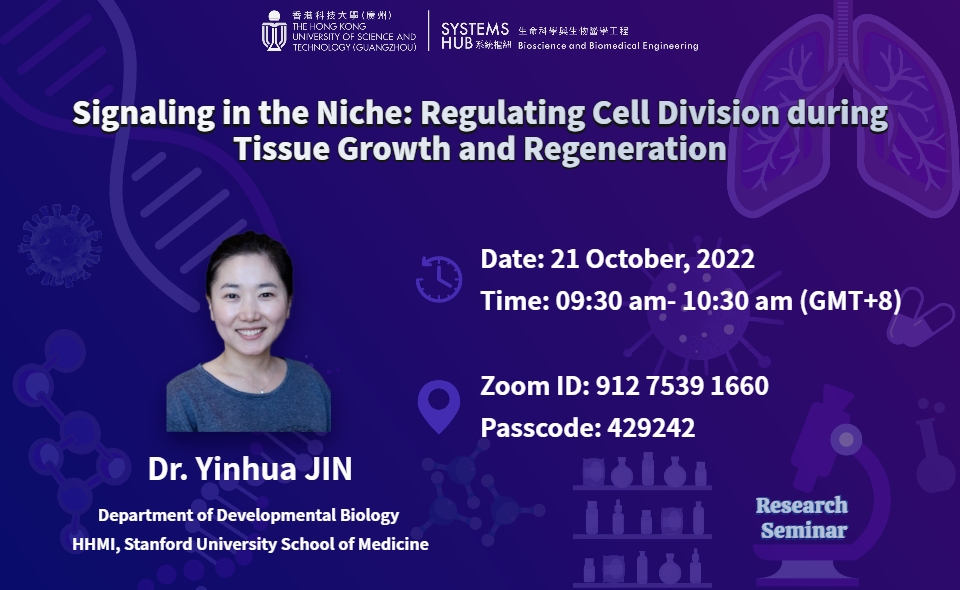
  • BSBE Seminar丨Dr. Yinhua JIN from Stanford University
    21 10 月 2022

    Stem cells are controlled by the microenvironment termed the “niche” to control tissue development, renewal, and regeneration. How niche signals dictate stem cell behavior is a central question underlying the use of stem cells in regenerative medicine. Niche signals such as EGF instructs cells to proliferate, while Wnt proteins act to maintain the proliferative capacity of cells. However, how these niche signals control cell division during tissue growth and regeneration is not fully understood. In this talk, I will show my work that identified molecular mechanisms of how niche signals such as EGF and Wnt control cell division, and how they contribute to tissue growth and regeneration. More specifically, I will focus on the novel mechanisms for Wnt signaling in control of cell cycle progression in the liver.

    生命科学与生物医学工程

文章导航

1 2 3 4
搜索
筛选
关注系统枢纽
  • 关于系统枢纽
  • 学域
  • 教育项目
  • 研究与知识转移
  • 新闻与媒体
  • 加入我们
© 版权属香港科技大学(广州)所有 粤ICP备20065231号