联系我们
HKUST(GZ)
我的门户
  • EN
  • ZH
  • ZH
  • 关于系统枢纽
    • 枢纽领导
    • 愿景与使命
    • 事实数据
    • 我们的团队
  • 学域
    • 生命科学与生物医学工程
    • 智能交通
    • 机器人与自主系统
    • 智能制造
  • 教育项目
    • 研究型硕博教育
    • 本科生教育
  • 研究与知识转移
    • 研究项目特色
    • 知识转移特色
  • 新闻与媒体
    • 活动
    • 新闻稿
    • 视频
    • 社交媒体
  • 加入我们
    • 联系我们
    • 招聘
活动 - 系统枢纽

新闻与媒体

> 新闻与媒体 > 活动
  • 活动
  • 新闻稿
  • 视频
  • 社交媒体
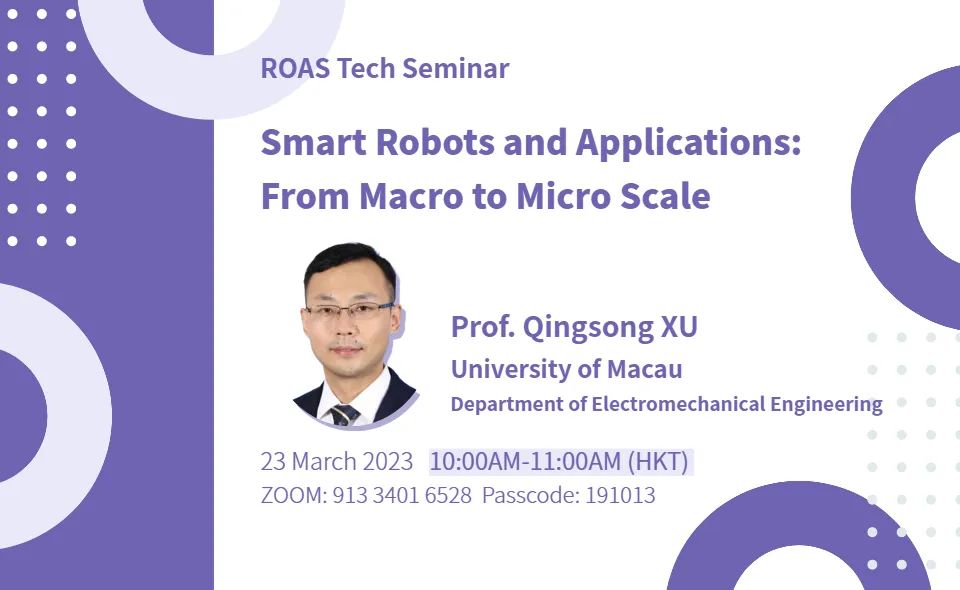
  • ROAS Seminar丨澳门大学 徐青松教授
    16 3 月 2023

    The past decades have witnessed spurred development of robots for various applications ranging from industry and service. Smart robots are demanding devices to realize automated manipulation of objects in multi-scale. Flexible robot manipulators based on compliant mechanisms provide precise and dexterous manipulation in macro/micro scales.

    机器人与自主系统
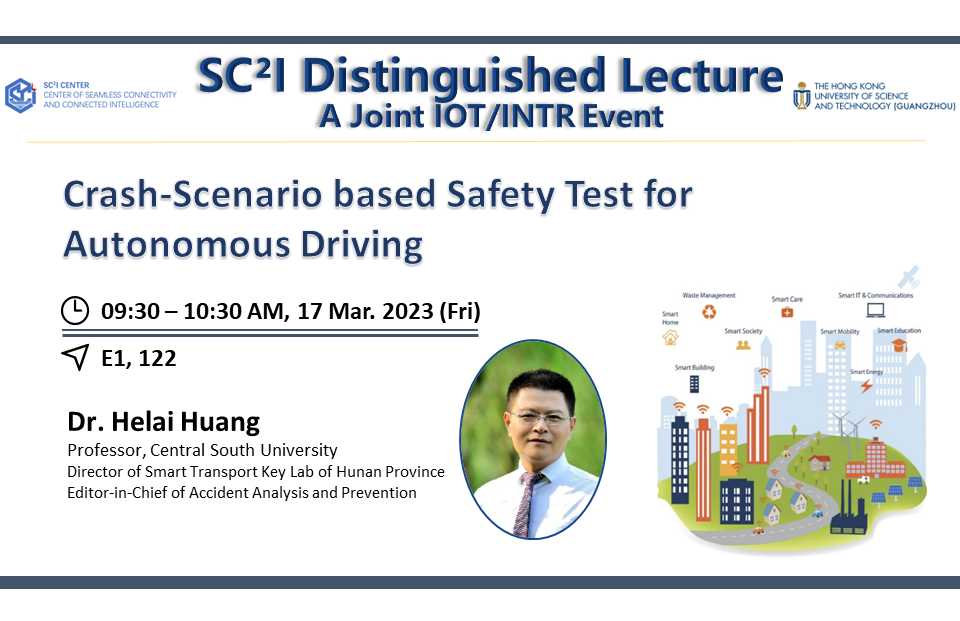
  • SC²I Distinguished Lecture | Prof. Helai Huang from CSU
    14 3 月 2023

    With the development of the autonomous driving technologies, the traditional vehicular test and evaluation methods cannot meet the testing requirements of Intelligent Connected Vehicles (ICVs). Scenario-based crash risk testing method has become one essential approach to the safety evaluation of ICVs. The construction of testing scenarios and the development of scientific testing methods as well as evaluation framework are the key scientific issues that need to be addressed. This presentation introduces in-depth crash data collection process and collision mechanism decoupling methods, and proposes a scenario-targeted testing method for ICVs. Then, a scenario derivation method is proposed to enlarge from a limited number of real crashes to a large number of high-risk scenarios. Finally, a hierarchical crash risk evaluation framework for ICVs is presented.

    智能交通
  • SC²I Distinguished Lecture | Prof. Songye ZHU from PolyU
    09 3 月 2023

    Construction activities frequently generate excessive vibrations that adversely affect nearby structures, facilities, and human beings. Vibration monitoring is commonly adopted to assess the impact of construction. Traditional monitoring solutions are associated with various limitations, such as high costs, specialized operation, difficult maintenance, and limited functions. Moreover, huge amounts of monitoring data cannot be efficiently used in other studies or projects due to missed information labels. This talk will present the recent efforts of my research group to address these problems by leveraging emerging IoT and deep learning approaches. IoT sensing solutions and deep learning-based semi-supervised classification of construction activities will be introduced.

    智能交通
  • SC²I Distinguished Lecture | Prof. Zhi TIAN from GMU
    25 2 月 2023

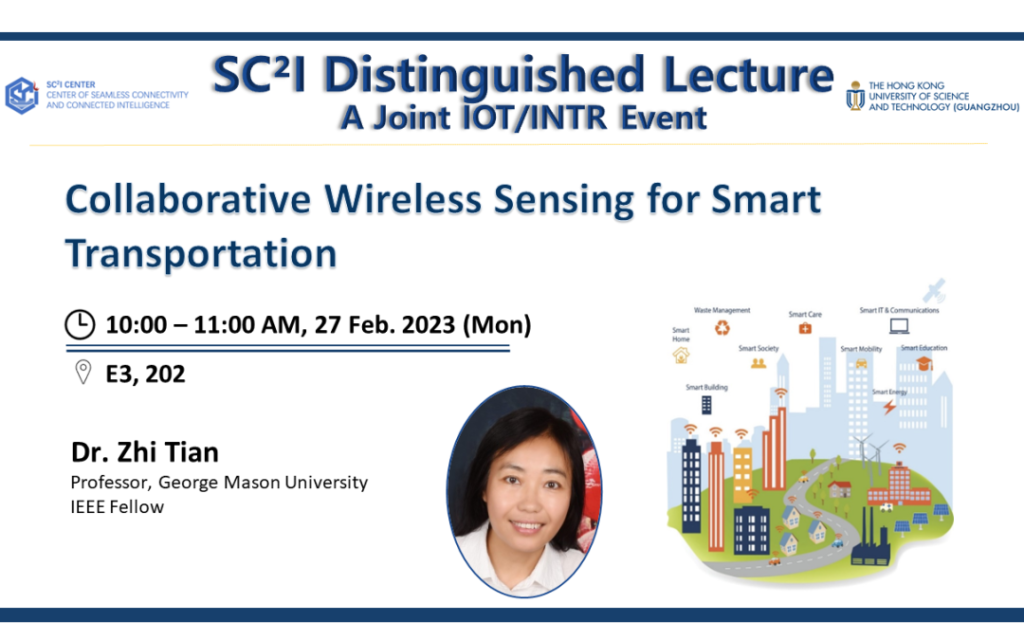
    Smart transportation hinges on collaborative machine learning among multiple distributed vehicles and the infrastructure to acquire real-time traffic patterns and road alerts for navigation with safety and efficiency. Collaborative learning is often carried out in a federated manner, where a number of distributed nodes jointly carry out a common learning task without sharing their private local raw data and often in the absence of centralized task coordination. These distributed nodes may adopt cognitive radio (CR) technology to dynamically share wireless spectrum, in order to improve the spectrum utilization efficiency. While federated learning is widely adopted in many distributed learning systems, it is not well suited for multi-task learning in heterogeneous network environments, such as for the wideband spectrum sensing problem in wireless CR networks. Given the limited sensing and communication capability of practical CR devices, individual CRs can only gain partial observations of the wide spectrum band, rendering the federated averaging algorithm inapplicable. Meanwhile, the limitations on sensing time and communication bandwidth make it ineffective for wireless CRs to collaboratively train a large-size deep neural network (DNN) model. To overcome these challenges in practical distributed systems, this talk presents our recent progress on cooperative wideband spectrum sensing via collaborative learning among heterogeneous CRs. A multi-task DNN architecture is introduced to detect wideband spectrum occupancy under partial observations, which decouples a dense DNN into band-specific sub-networks to enable heterogeneous feature extraction among collaborative CRs. A Spectrum Transformer architecture with multi-head self-attention mechanisms is also developed to efficiently capture the spectrum correlation from small data within a short sensing time. Simulation results illustrate the effectiveness of the developed techniques in coping with some practical issues in communication-efficient distributed learning for heterogenous networks.

    智能交通
  • SMMG 讲堂 | Dr. Yang XU
    22 2 月 2023

    Additive Manufacturing (AM) has been widely recognized as a disruptive manufacturing technology for various applications thanks to its capability of fabricating 3D objects with unprecedented geometric complexity and multiple functionalities. Also, AM enables revolutionary designs by using complex 3D shapes and heterogeneous materials. The structures with various material compositions and geometric feature sizes spanning from 10 μm up to 200 mm have a wide variety of interesting properties. However, the fabrication of such multi-scale and multi-material structures requires the integration of micro-, meso- and macro-scale manufacturing processes. How to develop AM processes to effectively and efficiently fabricate such structures with various engineering materials is still an open question.

    智能制造
  • 宣讲会回顾 | 期待与你一起“揾系统,万事通!”(含直播回放)
    17 2 月 2023

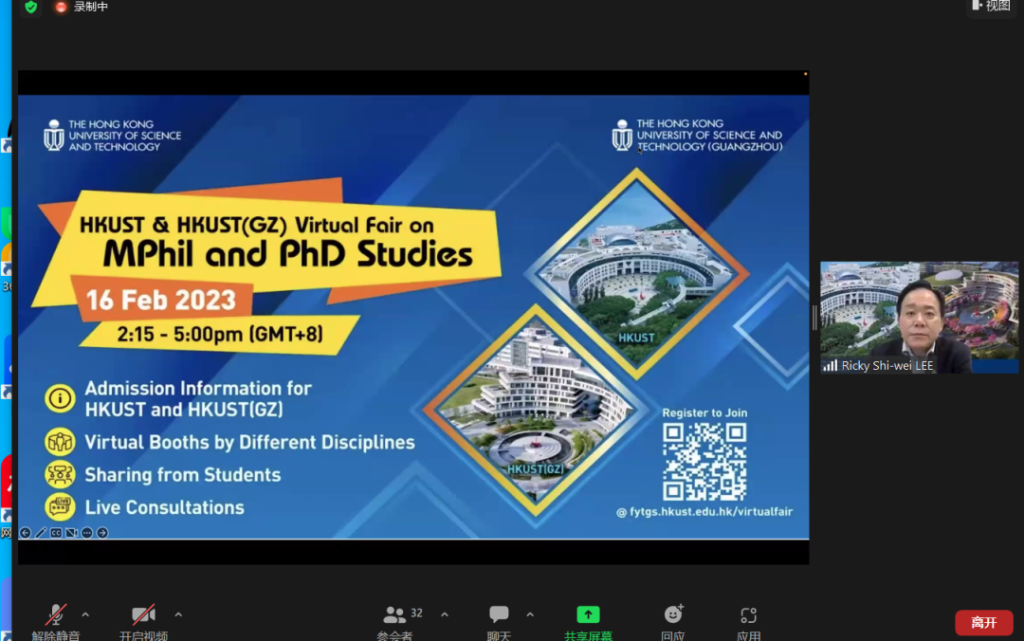
    2月16日下午,由香港科技大学与香港科技大学(广州)联合举办的国际招生在线展会暨宣讲会顺利召开,面向全球直播讲解港科大和港科大(广州)的研究型硕博项目。香港科技大学霍英东研究生院院长、香港科技大学(广州)副校长(研究生事务)吴宏伟教授出席并致辞。

    系统枢纽
  • INTR Seminar | Dr. An Wang from MIT
    15 2 月 2023

    The majority of the global population dwells in urban areas. Fast urbanization has led to numerous externalities in the transportation system, such as excess carbon emissions, air pollution, and mobility injustice, which are urgent to be resolved in a climate changing world. This research seminar demonstrates my interdisciplinary work on advancing a sustainable transport system. It starts from establishing a quantitative modeling framework for carbon and air pollution emissions from Canada’s largest metropolitan transportation system, the Greater Toronto and Hamilton Area. Personal carbon footprint is combined with granular socio-economic, land use, and travel activity data to investigate the existing environmental and energy justice concerns, revealing the association between high social disadvantage and low mobility-related emissions.

    智能交通
  • 活动回顾 | 2022-23 BSBE春季学期暨元宵Gathering
    13 2 月 2023

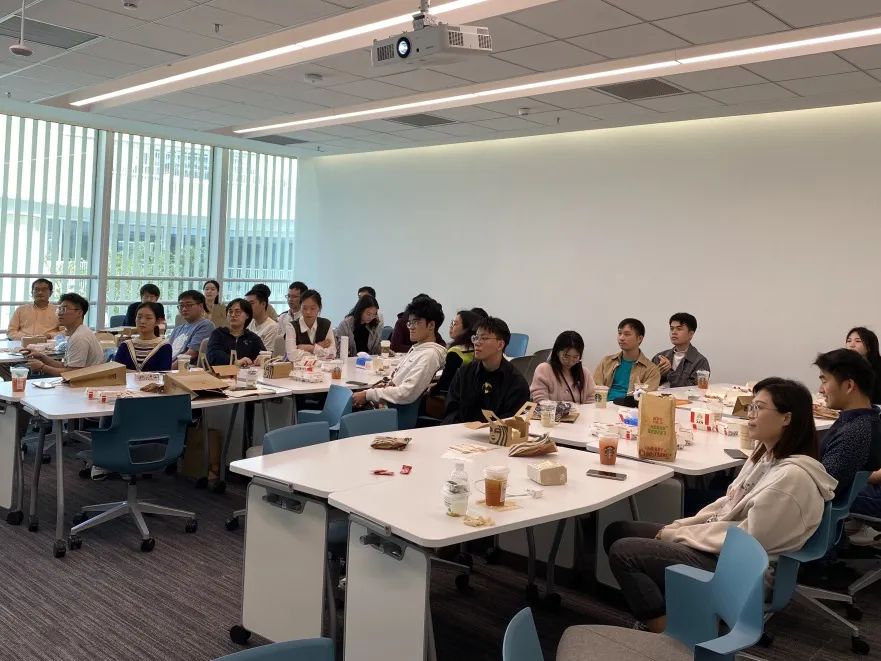
    2月9日下午,生命科学与生物医学工程(BSBE)学域举办了2022-2023春季学期暨元宵庆祝活动。BSBE的全体教职工和学生(MPhil & PhD)欢聚一堂,享用丰盛的下午茶、猜灯谜、相互畅谈对学业、研究及工作的心得与收获。

    生命科学与生物医学工程
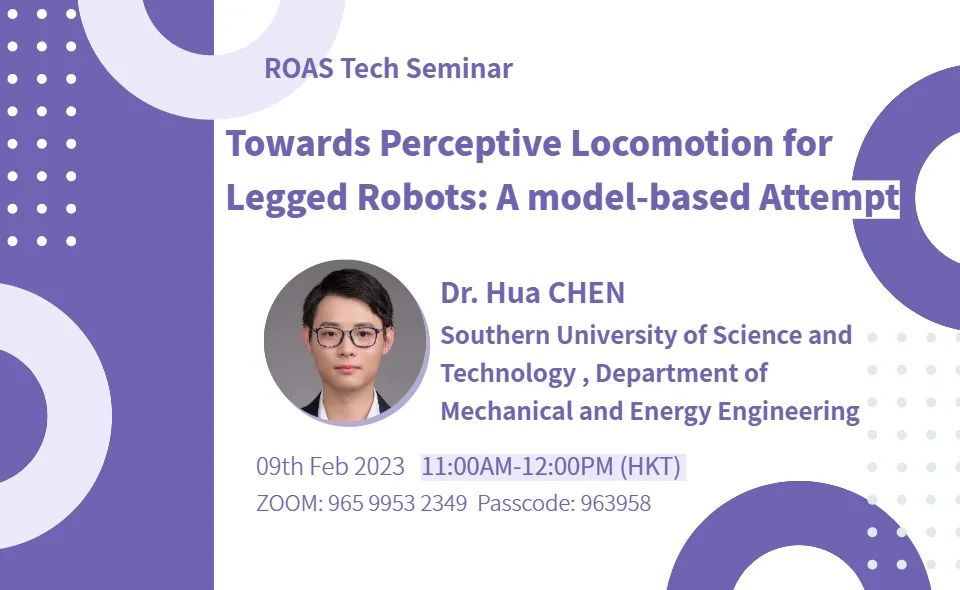
  • ROAS Seminar丨南方科技大学 谌骅博士
    08 2 月 2023

    Legged robots have attracted considerable attention from both academia and industry in recent years, thanks to their superiorities of traversing complex terrains and accomplishing complex tasks as compared to traditional wheeled mobile robots. These advantages make them well suited for various applications such as industrial surveillance, search and rescue, last-mile delivery, among others.

    机器人与自主系统
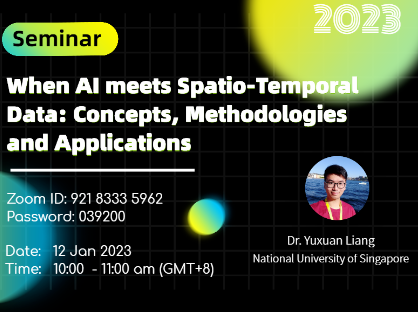
  • INTR Seminar | Dr. Yuxuan Liang from NUS, Singapore
    11 1 月 2023

    With the rapid advances in new-generation information technologies such as the Internet of Things, 5G, and mobile internet, Spatio-Temporal (ST) data are growing explosively. In contrast to image, text, and voice data, ST data often present unique spatio-temporal characteristics, including spatial distance and hierarchy, as well as temporal closeness, periodicity, and trend. Spatio-Temporal AI is a proprietary AI technology for ST data, where AI meets conventional city-related fields, like transportation, civil engineering, environment, economy, ecology, and sociology, in the context of urban spaces. This talk first introduces the concept of Spatio-Temporal AI, discussing its general framework and key challenges from the perspective of computer sciences. Secondly, we classify the applications of Spatio-Temporal AI into four categories, consisting of modeling ST point data, ST grid data, ST graphs, and ST sequences. We also present representative scenarios in each category. Thirdly, we delineate our recent progress in the methodologies of the above four categories. Finally, we outlook the future of spatio-temporal AI, suggesting a few research topics that are somehow missing in the community.
    智能交通

文章导航

1 … 9 10 11 12 13 14 15 … 19
搜索
筛选
关注系统枢纽
  • 关于系统枢纽
  • 学域
  • 教育项目
  • 研究与知识转移
  • 新闻与媒体
  • 加入我们
© 版权属香港科技大学(广州)所有 粤ICP备20065231号