联系我们
HKUST(GZ)
我的门户
  • EN
  • ZH
  • ZH
  • 关于系统枢纽
    • 枢纽领导
    • 愿景与使命
    • 事实数据
    • 我们的团队
  • 学域
    • 生命科学与生物医学工程
    • 智能交通
    • 机器人与自主系统
    • 智能制造
  • 教育项目
    • 研究型硕博教育
    • 本科生教育
  • 研究与知识转移
    • 研究项目特色
    • 知识转移特色
  • 新闻与媒体
    • 活动
    • 新闻稿
    • 视频
    • 社交媒体
  • 加入我们
    • 联系我们
    • 招聘
活动 - 系统枢纽

新闻与媒体

> 新闻与媒体 > 活动
  • 活动
  • 新闻稿
  • 视频
  • 社交媒体
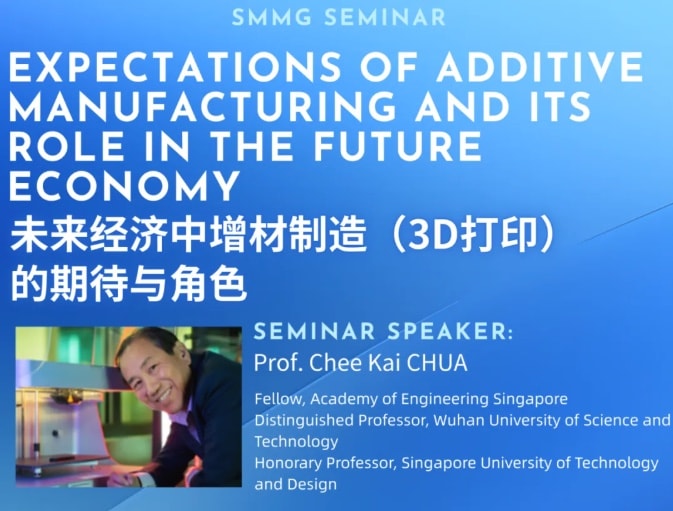
  • SMMG Seminar | 未来经济中增材制造(3D打印)的期待与角色
    28 2 月 2026

    Additive Manufacturing (AM), widely known as 3D printing, is transforming how we design, produce, and deliver physical products. This presentation by Prof Chua offers an in-depth look at the evolution of AM technologies, their classifications, and the unique advantages they bring over traditional manufacturing methods. Through the “5Cs” framework—Concrete, Copper, Circuits, Chocolate, and Cells—the talk illustrates the diverse applications of AM across fields such as construction, electronics, biomedical engineering, and food technology. Emerging trends like bioprinting, AI-assisted generative design, and Design for Additive Manufacturing (DfAM) are also explored, along with the push toward standardization, quality certification, and scalability for mass production. With rapid advancements in materials, processes, and digital integration, AM is positioned not just as a tool for innovation, but as a key enabler of next-generation manufacturing ecosystems—more efficient, personalized, and sustainable.
    智能制造
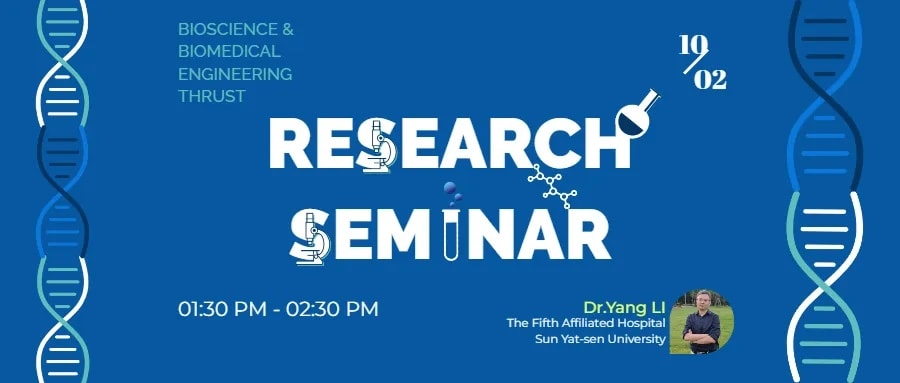
  • BSBE Seminar丨Dr. Yang LI from the Fifth Affiliated Hospital, Sun Yat-sen University
    09 2 月 2026

    Collagen provides vital mechanical support and a biochemical environment for nearly all human tissues. However, its signature triple-helical structure can be disrupted or denatured in diseases such as fibrosis, cancer, and arthritis. To detect these molecular changes, we developed Collagen Hybridization—a concept using synthetic peptides that selectively bind to unfolded collagen chains to form a hybrid triple helix without affecting intact collagen.

    生命科学与生物医学工程
  • ROAS Seminar丨Dr. Andreas Orthey
    28 1 月 2026

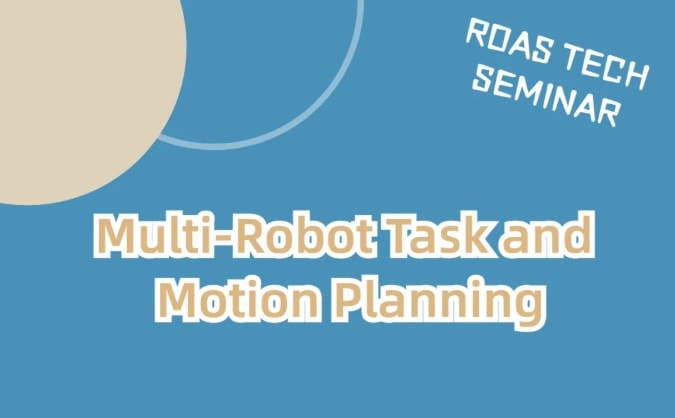
    This presentation introduces unified algorithms for multi-robot task and motion planning highlighting benefits like efficiency, cooperation, and redundancy. Part 1 focuses on multi-robot navigation in high-dimensional configuration spaces using Fibration Trees, enabling structural benchmarking against methods like RRT and FMT.

    机器人与自主系统
  • ROAS Seminar丨Dr. Fangqiang DING
    28 1 月 2026

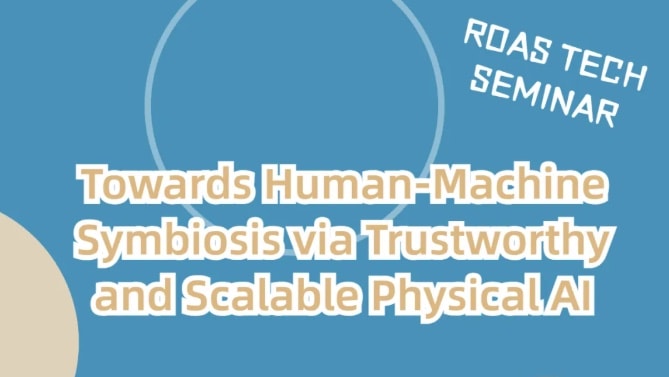
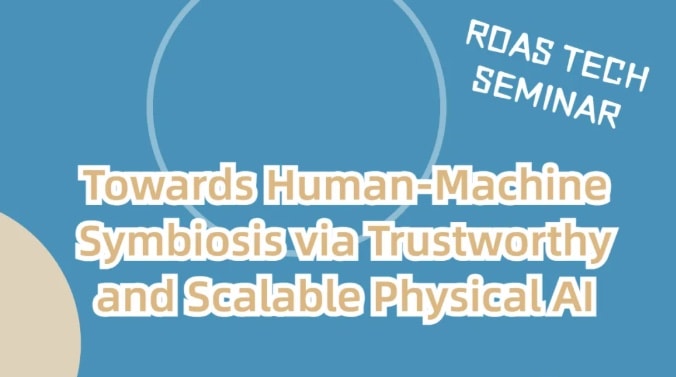
    Large AI models have transformed the digital workspace, writing documents and code, generating media, and executing agentic workflows for humans. The next step is to bring such capabilities into the real world, enabling physical systems to perceive, understand, and interact with real-world environments, i.e., Physical AI. I envision a future human–machine symbiotic ecosystem in which human and embodied intelligence coexist, collaborate, and co-evolve. Realizing this vision requires addressing several fundamental challenges: (i) complex and ever-changing real-world conditions (e.g., illumination, weather, and disasters), (ii) stringent privacy and sensitive-content protection requirements in human-centered applications, and (iii) the tension between limited deployment budgets and expensive hardware (sensors and computation) as well as costly data and annotation pipelines. Motivated by these challenges, my research aims to advance condition-adaptive, privacy-aware, and cost-effective Physical AI.

    机器人与自主系统
  • INTR Seminar | Dr. Anqi DONG from KTH Royal Institute of Technology
    28 1 月 2026

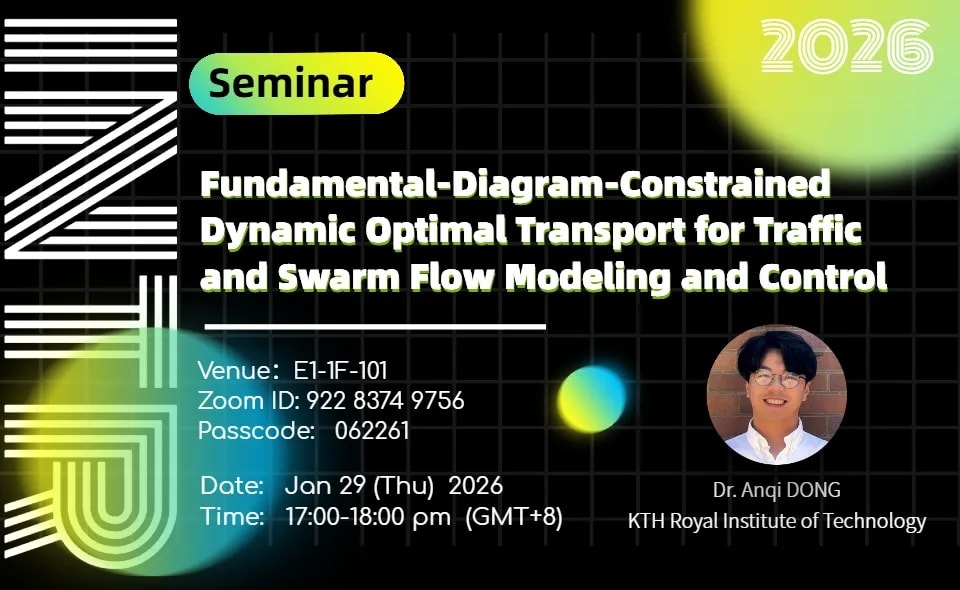
    Ninety years ago, Greenshields’ 1935 study of vehicular flow introduced what we now call the fundamental diagram. It captures a basic congestion effect: as density increases, speed drops from its free-flow value and goes to zero as density approaches the jam level. This simple relation gives a constitutive law that closes macroscopic traffic equations, and it underpins classical continuum models such as LWR and later second-order variants. In parallel, optimal transport has developed into a general framework for how distributions move under constraints. It is now widely used in swarm control, inference, and diffusion-based generative modeling. The viewpoint is to evolve densities rather than track individuals, and to choose the evolution that minimizes an action, often a kinetic-energy-type cost.

    智能交通
  • ROAS Seminar丨Dr. Fangqiang DING
    26 1 月 2026

    Large AI models have transformed the digital workspace, writing documents and code, generating media, and executing agentic workflows for humans. The next step is to bring such capabilities into the real world, enabling physical systems to perceive, understand, and interact with real-world environments, i.e., Physical AI. I envision a future human–machine symbiotic ecosystem in which human and embodied intelligence coexist, collaborate, and co-evolve. Realizing this vision requires addressing several fundamental challenges: (i) complex and ever-changing real-world conditions (e.g., illumination, weather, and disasters), (ii) stringent privacy and sensitive-content protection requirements in human-centered applications, and (iii) the tension between limited deployment budgets and expensive hardware (sensors and computation) as well as costly data and annotation pipelines. Motivated by these challenges, my research aims to advance condition-adaptive, privacy-aware, and cost-effective Physical AI.

    机器人与自主系统
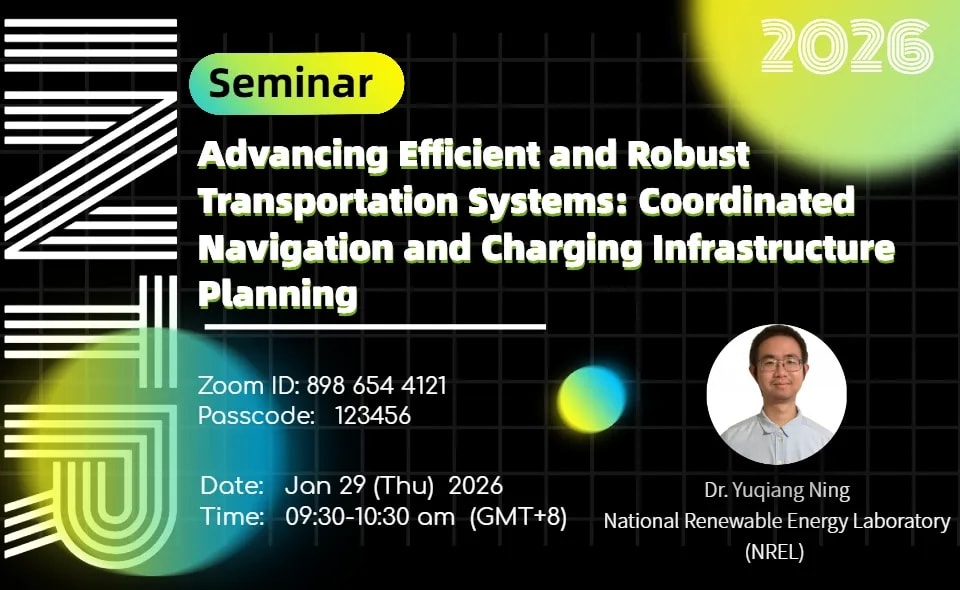
  • INTR Seminar | Dr. Yuqiang Ning from National Renewable Energy Laboratory (NREL)
    26 1 月 2026

    Transportation systems are essential to economic activity and social mobility, yet they face growing challenges from rapid urbanization, increasing travel demand, and the expanding integration of emerging technologies. This talk will cover part of my research that aims at advancing efficient and robust transportation systems, from both the operational decision-making and infrastructure planning perspective.

    智能交通
  • ROAS Seminar丨Dr. Yifu TAO
    19 1 月 2026

    Lidar and vision have complementary sensor characteristics for robot mapping in large-scale scenes. In this talk, I will present strategies for fusing the two sensor modalities using learning-based depth estimation and radiance fields. One challenge of applying learning-based methods is the inaccuracies in the neural networks, and we show how we handle them using aleatoric and epistemic uncertainty estimation through a Bayesian perspective.

    机器人与自主系统
  • ROAS Seminar丨Dr. Zeqing ZHANG
    15 1 月 2026

    In this presentation, I will provide a comprehensive overview of my research focused on the multimodal perception and manipulation of various types of deformable objects, including cloth, liquid, belts, and granular media. To structure the discussion effectively, I will categorize these projects based on their task difficulty, specifically into classification, estimation, semi-static operation, dynamic operation, and long-term manipulation.

    机器人与自主系统
  • ROAS Seminar丨Dr. Jiaen WU
    22 12 月 2025

    For decades, researchers have sought technologies that understand and support human movement with the same sensitivity and adaptability that humans use to maintain mobility in the real world. Achieving this requires systems that are perceptive, adaptive, and scalable.

    机器人与自主系统

文章导航

1 2 3 4 5 6 … 23
搜索
筛选
关注系统枢纽
  • 关于系统枢纽
  • 学域
  • 教育项目
  • 研究与知识转移
  • 新闻与媒体
  • 加入我们
© 版权属香港科技大学(广州)所有 粤ICP备20065231号